
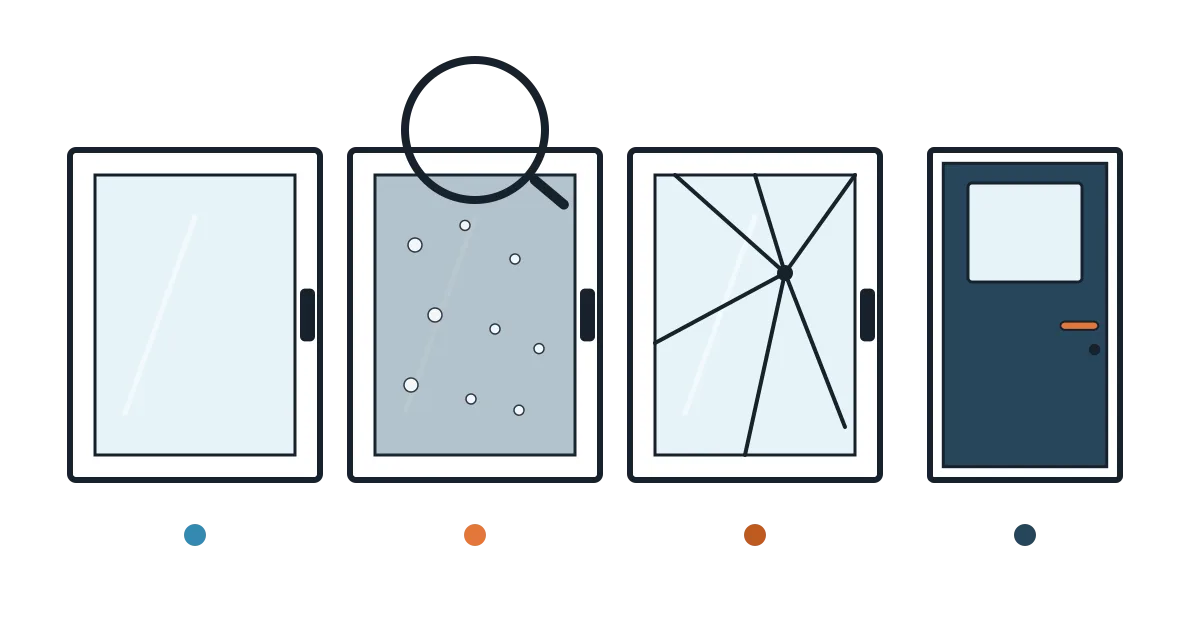
"My double glazing has gone wrong" covers a lot of ground. Misted glass, a cracked pane, a window that won't close and a front door that drops on its hinges all have different causes and different costs. Most of them start with a simple question: is the problem in the glass, or in the frame? This guide works through the common faults so you can match yours to the right service.
Start with where you can see the problem
What you can see, and what it usually means
| What you notice | Most likely fault | Where to look next |
|---|---|---|
| Cloudy or foggy glass with moisture trapped between the panes | The sealed unit's edge seal has failed | Misted double glazing replacement |
| Same, plus you want better insulation or safety glass | A failed sealed unit that can be upgraded | Blown double glazed unit replacement |
| A crack, chip or smashed pane | Broken glass | Double glazed glass replacement |
| Draughts, soft or rotten frames, or windows that won't shut | The frame has reached the end of its life | Double glazed window replacement or uPVC window replacement |
| A door that drops, sticks or won't lock | Worn hinges, a dropped door, or a failing multi-point lock | Double glazed door replacement |
Glass problems
Moisture between the panes
Misting between the layers means the sealed unit is no longer sealed. Damp air has got into the cavity and now condenses on the cooler pane. It's usually a gradual failure of the edge seal, and it's why you can wipe the glass on both faces and the cloudiness stays. "Misted" and "blown" describe the same fault. A new sealed unit is the normal fix, and the frame is usually kept. Our misted double glazing cost guide and blown unit cost guide explain the price. If the moisture is on a face of the glass instead, that is ordinary condensation, which is a ventilation question rather than a glass fault.
Cracks and breaks
A cracked pane can look stable and still fail suddenly, especially in a door or a low window. Thermal stress is a frequent cause: strong sun on part of a pane, or a cold pane next to a radiator. The repair is a new pane, usually as a full sealed unit. See the glass replacement cost guide.
Frame problems
If the glass is clear and only the window behaves badly, look at the frame. Typical signs are draughts around a closed window, hinges that have dropped so the sash has to be lifted to shut, perished seals, rotten timber cills, and uPVC that has gone brittle, yellowed or cracked at the welds. Hardware can sometimes be replaced, but when several things are wrong at once, a new window is usually the better spend. The window replacement cost guide and the uPVC window cost guide show what that involves.
Door problems
Doors take more wear than windows. A door that has dropped and drags on the threshold, a lock that has to be lifted or forced, and a leaf that has delaminated or warped are all common. A locksmith or the installer can often adjust hinges and replace a lock. If the door and frame are tired, a replacement is more sensible. See the door replacement cost guide.
Wipe the inside face, then the outside face. If the cloudiness doesn't move, it's between the panes and the unit has failed. If it wipes off, you've got ordinary condensation, which is a ventilation question, not a glass fault.
A simple order for working it out
- Look at the glass in good light. Is there moisture inside the layers, a crack, or neither?
- Check the frame: shut the window or door and feel for draughts, look at the seals, press the cill and bottom rail for softness.
- Try the hardware: handles, hinges and locks should work without lifting or force.
- Count how many faults there are and where. One bad pane in a good frame is a glass job. Several problems in one frame usually point to replacing the frame.
- Get itemised written quotes. The double glazing cost calculator gives you a range to compare them against.
If the picture still isn't clear, our signs your double glazing needs replacing checklist is a good next step.
How to work out which double glazing fault you have
- Look at the glass
In good light, check for moisture trapped between the layers, a crack or chip, or neither.
- Wipe both faces
Wipe the inside and then the outside face. If the cloudiness stays, it is between the panes and the sealed unit has failed.
- Check the frame
Close the window or door and feel for draughts. Look at the seals, and press the cill and bottom rail for soft or rotten wood.
- Test the hardware
Operate the handles, hinges and locks. They should work without lifting or force.
- Match the fault to a service
Glass faults point to a sealed unit or glass replacement. Several frame or hardware faults usually point to replacing the window or door.
Frequently asked questions
How do I tell if my double glazing has failed?
Moisture or a cloudy film between the two panes that you can't wipe off is the classic sign. Condensation on the inside or outside face is different and doesn't mean the unit has failed.
Is misted glass the same as a blown unit?
Yes, they describe the same problem. "Misted" is what you see, and "blown" is the seal failure behind it. The fix is a new sealed unit.
Can I just replace the glass and keep my frames?
Often, yes. If the frame is sound, a new sealed unit costs much less than a new window. If the frame is also worn, replacing the whole window can be better value.
Who should I call first?
For a single glass fault, a glazier. For frames, doors or several faults at once, a double glazing installer who can survey the whole property. Free quotes from local installers make a good starting point.
Ready to talk to a double glazed window replacement specialist?
Get Free Quotes →